- Your cart is empty
- Continue Shopping
What Does the Drug Bufo Hit in the Brain? Understanding Its Neuropharmacology
-
By admin
- Posted on
- 0 comments
- Guide
What Does the Drug Bufo Hit in the Brain”
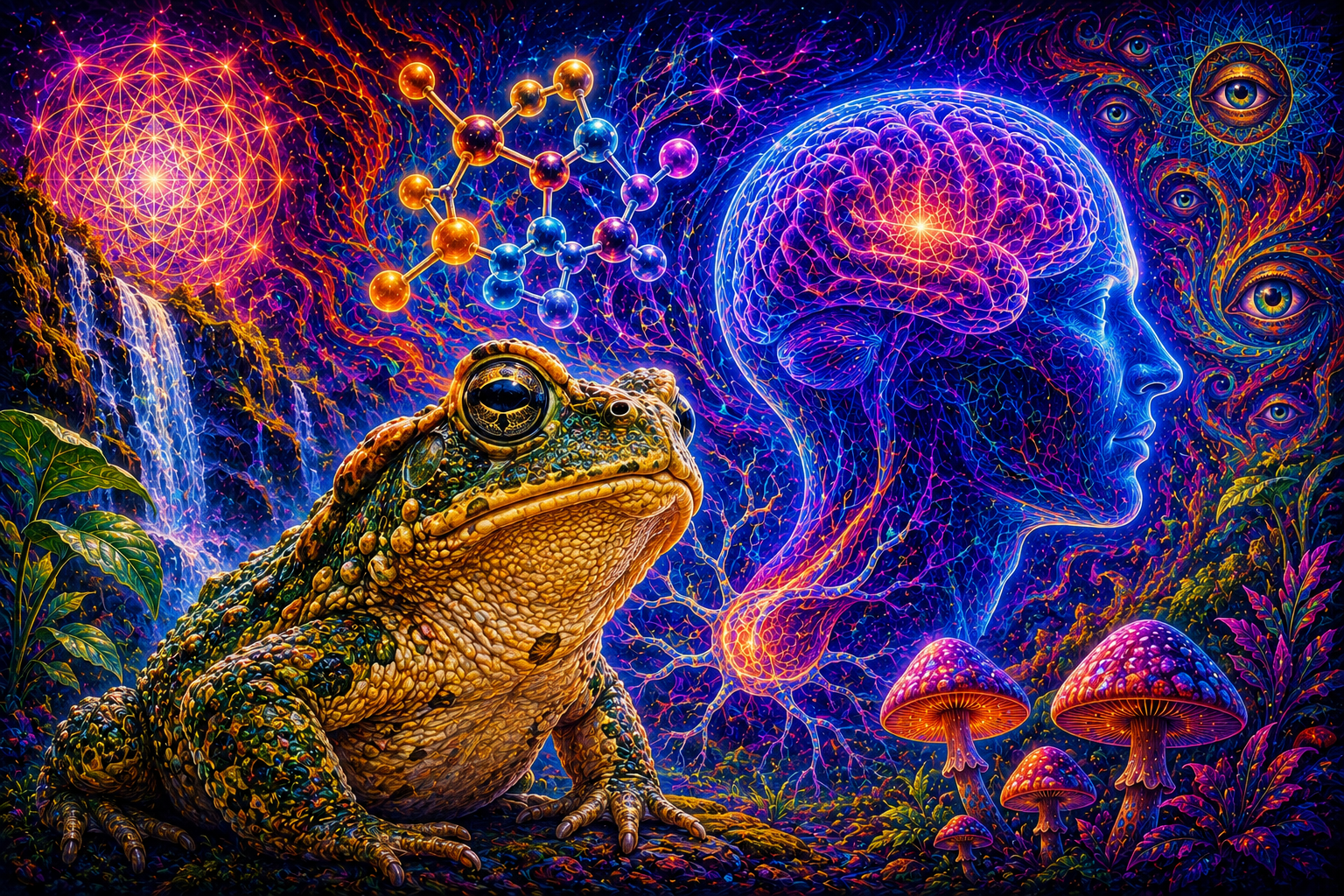
The growing scientific interest in psychedelic compounds has led researchers to investigate how naturally occurring substances interact with the human brain. Among the most studied is 5-methoxy-N,N-dimethyltryptamine (5-MeO-DMT), a naturally occurring tryptamine found in several plant species and in the defensive secretions associated with the Sonoran Desert toad (Incilius alvarius, formerly Bufo alvarius).
Although often referred to colloquially as “Bufo,” researchers emphasize that the biologically active compound of interest is 5-MeO-DMT, not the toad itself. Understanding how this compound affects the brain provides valuable insight into neuroscience, consciousness, and emerging psychedelic research.
At Psychedelic Ranger, we provide evidence-based educational content that explains the science behind psychedelic compounds while promoting public health, conservation, and responsible discussion.
What Is 5-MeO-DMT?
5-MeO-DMT belongs to a family of compounds known as tryptamines, which share structural similarities with the neurotransmitter serotonin (5-hydroxytryptamine or 5-HT).
Because of this similarity, 5-MeO-DMT can interact with serotonin receptors that help regulate:
- Mood
- Emotional processing
- Cognition
- Sleep
- Perception
- Stress responses
- Sense of self
Its unique receptor profile distinguishes it from many other psychedelic compounds.
Primary Brain Targets
Serotonin Receptors (5-HT)
Current research indicates that 5-MeO-DMT primarily interacts with the brain’s serotonin receptor system, particularly:
5-HT1A Receptors
Evidence suggests that 5-MeO-DMT has a high affinity for 5-HT1A receptors, which are involved in:
- Emotional regulation
- Anxiety modulation
- Stress responses
- Autonomic nervous system function
- Mood regulation
Activation of these receptors may contribute to some of the profound psychological effects reported in research settings.
5-HT2A Receptors
Like several other classic psychedelics, 5-MeO-DMT also interacts with 5-HT2A receptors, although its pharmacological profile differs from compounds such as psilocybin or LSD.
The 5-HT2A receptor is associated with:
- Altered perception
- Cognitive flexibility
- Sensory processing
- Self-referential thinking
- Conscious awareness
Researchers consider this receptor central to understanding many psychedelic experiences.
Effects on Brain Networks
Brain imaging studies of psychedelic compounds suggest changes in communication among large-scale neural networks.
Researchers are investigating effects on:
Default Mode Network (DMN)
The Default Mode Network is associated with:
- Self-reflection
- Internal dialogue
- Personal identity
- Autobiographical memory
Temporary changes in activity within this network have been associated in research settings with altered self-awareness and changes in subjective experience.
Functional Connectivity
Some studies suggest psychedelic compounds may temporarily alter communication between brain regions that do not usually interact extensively.
Scientists continue investigating how these changes relate to perception, cognition, and emotional processing.
Neuroplasticity Research
One of the most exciting areas of psychedelic neuroscience involves neuroplasticity—the brain’s ability to adapt by forming and reorganizing neural connections.
Laboratory and preclinical studies have explored whether psychedelic compounds may influence cellular pathways involved in:
- Synaptic remodeling
- Neural growth
- Learning
- Memory
- Adaptive brain function
These findings are promising but remain an active area of research.
Current Areas of Scientific Investigation
Researchers continue studying 5-MeO-DMT and related compounds in relation to:
- Depression
- Anxiety disorders
- Trauma-related conditions
- Emotional processing
- Consciousness research
- Neuroplasticity
- Brain network dynamics
Most studies are conducted in controlled research environments with careful participant screening and medical oversight.
Safety Considerations
Because 5-MeO-DMT can produce profound changes in perception and physiology, researchers emphasize the importance of medical screening and professional oversight in legitimate clinical research.
Potential risks may include:
- Anxiety or panic
- Elevated blood pressure
- Temporary confusion
- Psychological distress
- Adverse interactions with certain medications
- Increased risk for individuals with some cardiovascular or psychiatric conditions
Conservation and Ethics
Growing public interest has increased attention on the Sonoran Desert toad. Conservation organizations encourage protecting wild populations and respecting biodiversity. Many researchers favor studying laboratory-produced 5-MeO-DMT to reduce pressure on wildlife and ensure standardized research materials.
Frequently Asked Questions
Is “Bufo” the same as 5-MeO-DMT?
Not exactly. “Bufo” is an informal term often associated with the Sonoran Desert toad and its defensive secretions. The compound most commonly studied by scientists is 5-MeO-DMT, one of several naturally occurring substances associated with those secretions.
Which brain receptors are most important?
Current evidence indicates that 5-HT1A and 5-HT2A serotonin receptors are the primary targets involved in the compound’s effects.
Why are neuroscientists interested in 5-MeO-DMT?
Researchers hope that studying its effects on serotonin signaling, brain networks, and neuroplasticity may improve understanding of consciousness and contribute to future treatments for selected psychiatric conditions.
Is research still ongoing?
Yes. Universities and research institutions worldwide continue investigating the pharmacology, safety, and potential therapeutic applications of 5-MeO-DMT.
Conclusion
The neuropharmacology of 5-MeO-DMT represents one of the most intriguing areas of contemporary psychedelic research. By interacting primarily with serotonin receptor systems and influencing large-scale brain networks, the compound offers researchers valuable insights into consciousness, emotional regulation, and neuroplasticity.
Although scientific understanding continues to advance, many questions remain about long-term effects, optimal clinical applications, and mechanisms of action. Continued research conducted under rigorous ethical and medical standards will be essential for expanding knowledge while protecting participant safety.
At Psychedelic Ranger, our mission is to provide accurate, evidence-based educational resources that support scientific literacy, public health, and informed discussion about psychedelic medicine and neuroscience.